Exploring our encounters and entanglements with the environment and introducing students to the exciting and vital work of humanistic inquiry
In our new curricular cycle from 2025–2028 under the program direction of Professor Rebecca Davis, Humanities Core will focus on the theme of Environment | Encounter | Entanglement. This cycle begins with a provocation: As our world veers toward ecological catastrophe, who can afford to study the humanities? We answer: Who can afford not to?
The environmental humanities is an emerging field of study that understands environmental challenges as deeply interlinked with social, cultural, and human factors. It interrogates the assumed divide between nature and culture, positing in its place a web of relations between the human and more-than-human world. From this perspective, environmental crises cannot be solved by techno-scientific means alone. Humanistic methods of inquiry are essential not only for understanding the conditions that gave rise to these crises, but also for charting new paths forward. As theorist Ursula Heise writes, the environmental humanities “envision ecological crises fundamentally as questions of socioeconomic inequality, cultural difference, and divergent histories, values, and ethical frameworks.” Humanists are in a unique position to tell these stories, and, indeed, to imagine better stories of collective flourishing in the future.
Lectures from nine extraordinary, award-winning professors representing eight departments and programs will survey a range of environmental entanglements both real and imagined.

English and
Center for Early Cultures

English
East Asian Studies and Environmental Humanities Research Center
Art History

History
History

English and Center for Critical Korean Studies

Comparative Literature and
Native American and Indigenous Studies
East Asian Studies
And in small seminars, students will engage closely with this complex material while developing rhetorical awareness and communication skills that will serve them in every academic discipline and in public life.
As always, Humanities Core will be more than just a class. Thanks to our partnerships with the Humanities Center, UCI Illuminations, and the Environmental Humanities Research Center, HumCore will be a first-year experience and gateway to the broader university community. Special events will bring many of the celebrated authors, artists, and scholars we are studying to campus for conversations with our students. Events with journalists, curators, and designers in cutting-edge creative industries will show students how work is done in humanistic fields. Students can attend guided nature walks, world-class theatre performances, film screenings, museum exhibitions, and hands-on workshops to explore special archival collections.
Fall Quarter: Entangled Narratives
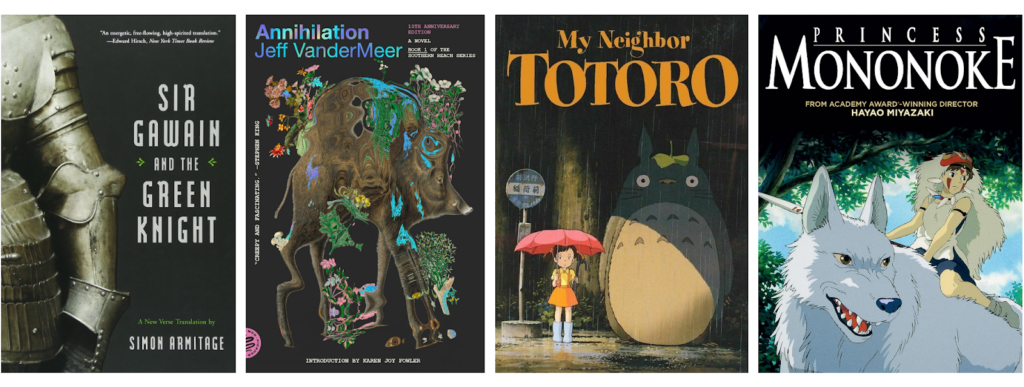
This quarter, students will consider how stories shape our understanding of environmental relationships and responsibilities. Lectures by Professor Rebecca Davis (English), Professor Ted Martin (English), and Associate Professor Jon Pitt (East Asian Studies and Director of the Environmental Humanities Research Center) will explore how various artistic genres—from Arthurian quest to climate fiction and animated films—reveal the intricate connections between the human and more-than-human worlds. We will analyze how works like Sir Gawain and the Green Knight, Jeff VanderMeer’s Annihilation, and Miyazaki Hayao’s My Neighbor Totoro and Princess Mononoke interrogate the concept of nature as an untouched wilderness or Edenic garden existing apart from human culture. Instead, these stories present a reality where the “natural” and “cultural” are deeply interwoven, suggesting interdependency and shared agency. In these texts, plants and non-human animals are entangled with human life in ways that challenge narratives of human exceptionalism. By examining these interconnections, students will consider how varied narrative forms across time critically reassess the divide between human and more-than-human life.
Lectures will expose students to the analytic methodologies of literary studies in English and East Asian Studies, and will introduce them to interdisciplinary fields of the environmental humanities and critical plant studies. In seminars, students will be guided through the transition between high school and college-level writing and communication. They will write two essays, a Close Reading of Sir Gawain and the Green Knight and a Literary Analysis of Annihilation, and will build a basic website to house their ongoing multimodal reflections about their explorations in the course.
Winter Quarter: Material Environments

Lectures by Professor of Art History James Nisbet, Associate Professor of History Chelsea Schields, and Professor of History Renée Raphael will explore how historical research and forms of creative expression help us better understand, and perhaps begin to redress, the environmental legacies of racial capitalism, colonialism, and exploitative resource extraction. Students will analyze shifting attitudes towards the environment in nineteenth-century landscape painting and contemporary environmental art, including works by Indigenous artists like Kent Monkman, Rebecca Belmore, and Bonnie Devine that culturally reclaim unceded lands and Black artists like Noah Purifoy and LaToya Ruby Frazier that represent the experience of marginalized communities. They will study archival primary documents related to the historical development of the oil industry, with a focus on modes of social reproduction in sites from the sugar plantation to the oil boomtown to the present-day offshore rigs, remote fields, and vast refineries that fuel the global petroleum market. Students will learn about the how emergent scholarly field of the Energy Humanities analyzes the current environmental crisis and helps us to imagine new ways of living in the world. And, finally, through the lens of the History of Science, we will explore early modern mining practices in premodern Europe and colonial Latin America and West Africa to think deeply about the historical and technological contingency of our very conceptions of matter.
Through our unique collaboration with UCI Libraries Special Collections and Archives, students will explore the rare objects housed on our campus which represent a variety of environmental projects and perspectives. In seminars, students will continue to develop their online presence with increasing focus on specific humanistic topics and methodologies. They will learn how to work with primary sources and scholarly secondary sources by writing two expository essays: a Visual Analysis of an artwork by Kent Monkman and a Rhetorical Analysis of an Archival Petroculture Primary Source.
Spring Quarter: Crisis, Care, and Community
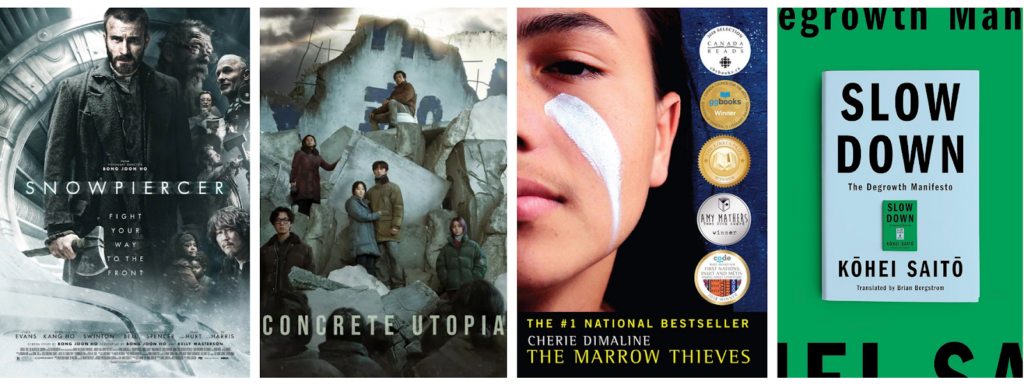
In the final quarter, students will examine communities of survival and care that develop in response to environmental crises in Korean cinema, Native American speculative fiction, and Japanese and Indigenous environmental activism through lectures by Professor of English and Director of the Center for Critical Korean Studies Joseph Jeon, Associate Professor of Comparative Literature John Gamber, and Professor of East Asian Studies Margherita Long. Students will analyze contemporary Korean films such as Bong Joon-ho’s Snowpiercer and Um Tae-hwa’s Concrete Utopia, examining how these works envision societal responses to urbanization, natural disaster, and the post-apocalypse. They will engage with Indigenous futurism in Métis author Cherrie Dimaline’s young adult novel The Marrow Thieves, exploring Native cosmologies in contrast to the anthropocentrism and human exceptionalism of settler worldviews and religions. And they will study Japanese environmental activism by analyzing an ecodocumentary and ethnographic accounts of the Minamata mercury poisoning incident. To think critically about these cultural texts, students will explore theories about degrowth in the work of Saitō Kōhei, Indigenous scholarship on environmental justice, and decolonial approaches to ecology.
Drawing on the many writing and research skills they have learned over the course of the year, students will produce a capstone research project centered on their own interests in relation to the cycle theme and will communicate their findings to both academic and broader online public audiences through forms of dynamic online production like podcasts and video presentation.
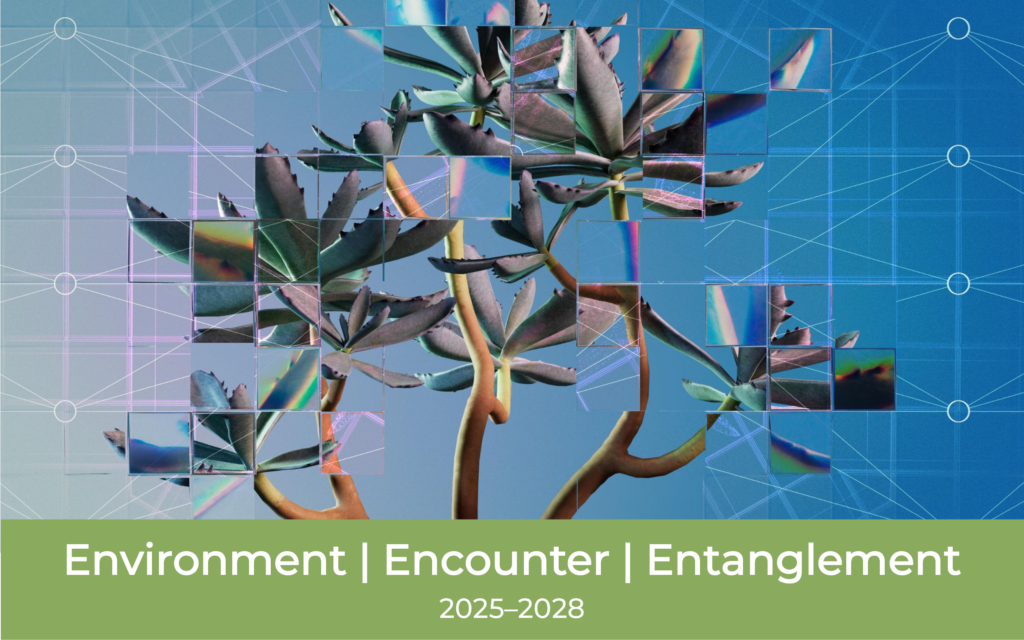
Top image credit: Alan Warburton, Nature, Better Images of AI, image by BBC